15 European flights diverted after wave of bomb threats
Coordinated hoaxes involving multiple low-cost carriers prompted emergency landings and security checks across the continent on Thursday.
By Sarah Reynolds ·
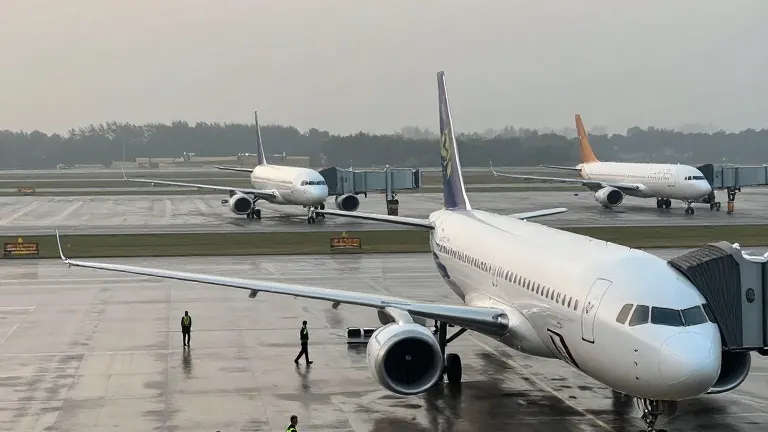
At least 15 flights across Europe were diverted or made emergency landings on Thursday morning following a series of bomb threats. The incidents involved airlines including Ryanair, Aer Lingus, Wizz Air, Finnair, and LOT Polish Airlines. All aircraft landed safely, and initial searches found no suspicious items.
The warnings affected routes connecting Italy, Ireland, the UK, Spain, Bulgaria, Romania, Poland, Finland, Austria, Denmark, Belgium, Portugal, Greece, and Czechia. Two Ryanair flights from Copenhagen and Madrid landed in Sofia, while another Ryanair plane from London diverted to Plovdiv. A Bulgarian government spokesperson stated that inspections at both airports found no issues and that operations had returned to normal.
Other diversions included an Aer Lingus flight from Dublin to Rome, which landed at the Évreux-Fauville military airbase in northern France. A Wizz Air flight from Milan to Warsaw diverted to Vienna. In Italy, Ryanair and Aegean Airlines flights were searched upon arrival at Milan’s Malpensa airport. Czech police confirmed that security measures at Prague airport ended with negative results from pyrotechnic inspections.
This disruption follows a similar wave of threats on Tuesday that affected seven planes and a single diversion on Monday. Aviation experts note that while fake threats are common, the volume of credible alerts suggests coordinated action. Capt Martin Drake, a former airline pilot and technical adviser to the Balpa union, explained that airlines use a traffic-light system to assess risks. A red alert typically requires a rapid descent and diversion to the nearest airport.
Drake added that at cruising altitude, aircraft pressurization would likely neutralize the force of an improvised explosive device. The ready availability of airline schedule and technical data online allows hoaxers to target specific flights with greater precision than in the past. Diversions are costly and disruptive, but airlines have little choice when facing credible threats.
The Italian news agency Ansa reported that police sources identified an anonymous email in Italian as the source of warnings for the Helsinki-Rome and Dublin-Rome flights. The email was sent to the Rome airport company and other affiliated firms with the subject line “segnalazione minaccia,” which translates to “threat warning.” A Finnair representative described the threats against its flights as unfounded or hoax, noting that threats are almost always unfounded.
Some analysts link the travel disruption to recent cyber-attacks on supermarket refrigeration systems and drone incursions, speculating it may be part of a hybrid campaign by state actors. Dmitry Peskov, a Kremlin spokesperson, called it “absurd” to blame Russian administration for the hackers targeting fridges, citing baseless accusations against the country.
Rhys Jones, an analyst at Osprey Flight Solutions, said the threats appeared linked but chaotic, with no specific region targeted. He noted that while security protocols will remain standard, the incidents will likely lead to increased security measures and public concern. Jones observed that creating disruption may be a goal for those carrying out the hoaxes.