Atmospheric Physics: The Meteorology Behind Lenticular Clouds
Meteorologist Tawana Andrew explains how wind interacts with terrain to create stationary, lens-shaped cloud formations that often resemble unidentified flying objects.
By Sarah Reynolds ·
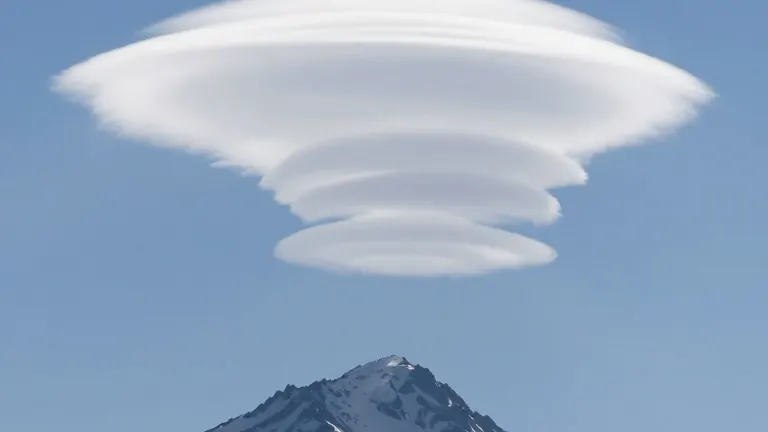
Lenticular clouds form when wind encounters physical obstructions on Earth's surface, creating a stable atmospheric condition that results in stationary, lens-shaped formations.
Tawana Andrew, a meteorologist speaking with Bill Burton this week, explained that the process begins when air moves across mountains, hills, or buildings. This interaction disrupts the wind's flow and generates turbulence downstream. In a stable atmosphere, this turbulence creates gravity waves. If the air temperature at the crest of these waves drops to the dew point, condensation occurs and clouds form.
Andrew noted that the stable atmosphere resists vertical motion, causing the air to return to its original altitude. As the air rises and falls within the wave, water vapor condenses into liquid water and then evaporates back into vapor. This continuous cycle of development and dissipation happens at the crest and trough of the gravity waves, making the cloud appear fixed in place even as wind flows rapidly through the area.
Andrew identified three distinct types of lenticular clouds based on altitude and water phase. The highest form, known as cirrocumulus standing lenticular clouds, consists mainly of ice crystals and forms above 18,000 feet. These appear delicate and wispy. The middle type, altocumulus lenticular clouds, contains a mixture of ice and water and forms between 8,500 and 24,000 feet. Andrew stated that these are the most dynamic in appearance, featuring a fluffy texture and a well-defined lens-like outline that most closely resembles a flying disc.
The lowest form, stratocumulus lenticular clouds, is composed almost entirely of liquid water droplets and forms below 8,500 feet. Andrew described this type as thicker and more uniform in appearance but noted that it is rarer than the other two varieties.
According to Andrew, the stationary appearance of these clouds contributes to their mysterious reputation. She emphasized that lenticular clouds serve as a visible indicator of atmospheric turbulence and gravity waves, providing insight into conditions that may not otherwise be apparent to observers.