69 killed in Spain rail crash as signaling failure prompts political crisis
The second fatal collision on the same line in a year has led Prime Minister Pedro Sánchez to admit public trust is broken, while Transport Minister Óscar Puente faces calls to resign ahead of next month's election.
By Sarah Reynolds ·
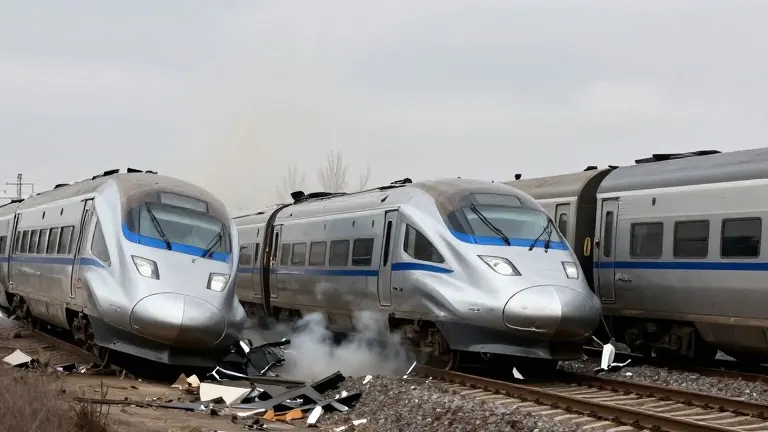
At least 69 people died and more than 100 were injured when two high-speed trains collided in central Spain on Wednesday, marking the second deadly crash on the same route in nine months. The victims included residents from at least 23 different foreign countries. Prime Minister Pedro Sánchez stated on Friday that public trust in the country's high-speed rail network has been broken.
The collision occurred just before 9 a.m. near Urda in the Castilla-La Mancha region. A Renfe state-owned train and a private Iryo train were traveling from Madrid toward Andalusia. The Iryo train came to a halt, and the Renfe train subsequently struck the rear of the stopped vehicle, sending several carriages off the tracks. A preliminary investigation released Thursday found the Renfe train was traveling between 160 km/h and 200 km/h at impact, significantly exceeding the 40 km/h protocol speed required when automated systems fail.
Transport Minister Óscar Puente indicated that the LZB signaling system, which automatically stops trains if the track ahead is occupied, had failed. He said control reverted to human operators at the Adif state infrastructure center in Madrid. An operator ordered the Renfe train to move at normal speed rather than the mandated low speed. The operator, a 48-year-old man with two years of experience in control centers, had managed the specific sector since February.
Puente dismissed calls for his resignation during a press conference, stating his focus was on solving problems and clarifying events. He said, "My duty now isn't to talk about whether or not I carry on with my job; it’s to solve the problems, clarify what happened and offer clear explanations." He added that if the investigation revealed organizational failures or individual responsibility, the government would act accordingly.
Railway traffic controllers' union SCF pushed back against placing blame on a single worker. Spokesperson Raquel Ayllón told the Associated Press that human error was understandable given the conditions, but the regular failure of the safety system was not. She argued that workloads are too demanding for safe operation and called for more personnel.
Political pressure has intensified ahead of next month's snap general election. The conservative People's Party, led by Alberto Núñez Feijóo, holds Puente and Sánchez politically responsible for both crashes. Feijóo stated that those who failed in their duties must bear the consequences, and if they do not resign, voters will remove them. Ada Colau, leader of the leftwing Frente Amplio coalition, also demanded Puente's immediate departure, urging the government not to debate the timing of the resignation.
Sánchez said the government is working tirelessly to provide information to victims' families and find causes. He emphasized that the government's responsibility extends beyond diagnosis to providing solutions to ensure a tragedy of this scale does not happen again. Puente said he had given "zero thought" to the potential effect of the crash on the election campaign.
Source: The Guardian