Aerial firefighting firms unveil larger tankers and new data tools in Boise
TracPlus, Neptune Aviation, and Perimeter Solutions presented updated retardant formulas and aircraft conversions at the JUMP conference, aiming to improve drop accuracy and capacity.
By Matthew Collins ·
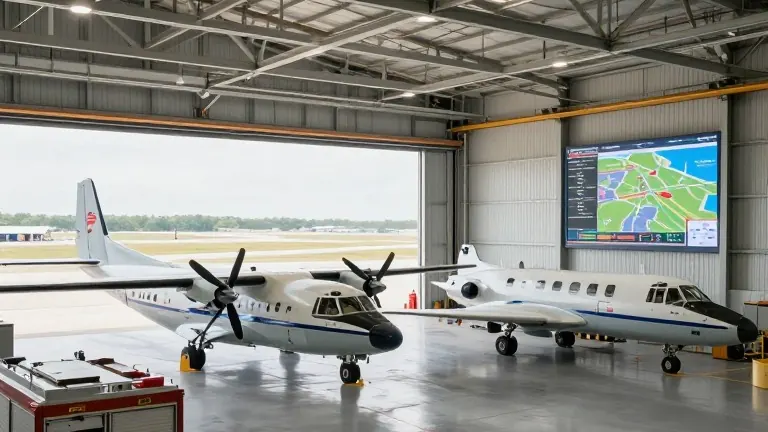
Aerial firefighting companies from across the globe convened in Boise, Idaho, on Wednesday to present new aircraft conversions and data management systems designed to improve wildfire response. The gathering, known as JUMP, focused on modernizing an industry that Todd O’Hara of TracPlus described as having remained static for four to five decades while fire conditions worsened.
O’Hara stated that the sector has struggled to keep pace with increasing fire intensity. TracPlus, a New Zealand-based firm, currently tracks approximately 3,500 aircraft worldwide. The company collects flight data alongside operational metrics such as the volume and location of retardant drops. O’Hara explained that the firm is developing a repeatable mathematical model to standardize decision-making for pilots with varying levels of experience.
The conference also featured updates on equipment and chemical formulas. Jim Karels of Perimeter Solutions noted that retardant formulations are shifting from a traditional dark red to a fuchsia pink. Karels said the new color is easier to identify from both the air and the ground and dissipates more quickly after application. His team is modifying these formulas to ensure they remain effective when used with specific air tanker models.
Neptune Aviation presented plans to expand its fleet capacity. Nic Lynn of Neptune Aviation announced the development of a new large air tanker that will carry 4,500 gallons of retardant. This represents a 50% increase over the company’s current 146 model. Lynn said the higher capacity allows crews to drop more material in fewer trips, enabling the construction of longer fire lines with greater efficiency.
Lynn reported that Neptune Aviation dropped 606,000 gallons of retardant in Idaho during the current fire season. The company is also converting an Airbus A319 into a dedicated firefighting plane to further support these operations. These updates follow the Claremont Fire in Boise this summer, where crews tracked aircraft drops using the new data visualization tools.
The presentations concluded with a focus on integrating flight data with chemical performance to create a more cohesive aerial response strategy.
Source: KIVI-TV
More Business · Bad Service · Report a business · Got a Story?