Judge to decide who pays for Mill A cleanup
A four-week trial has begun in Whatcom County Superior Court to determine the financial split between the Port of Everett and Weyerhaeuser for remediation costs at the former sawmill site.
By Amina Yusuf ·
Superior Court Judge Jon Scott opened proceedings on Monday to resolve a dispute over how to divide the costs for cleaning up the Mill A site at 3500 Terminal Ave. The trial will determine the financial responsibility of the Port of Everett and the timber company Weyerhaeuser for waste materials left behind by decades of industrial operations.
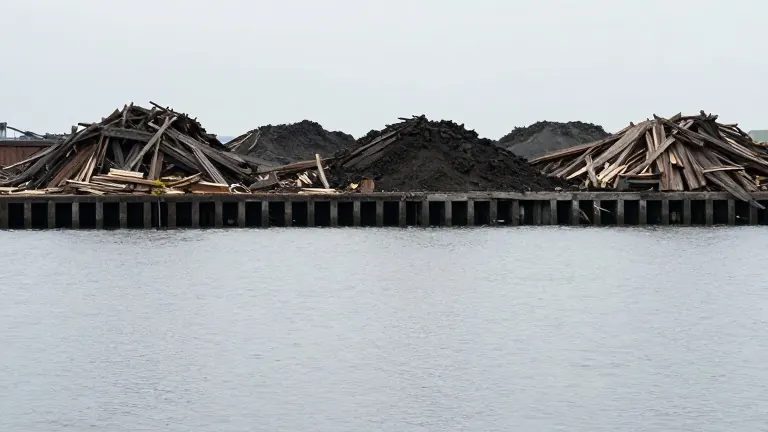
The site hosted Weyerhaeuser sawmill and pulp mill operations starting in the 1890s. Industrial lumber activities ceased at the location in 1980. The Port of Everett purchased the property in 1983. The Port used the facility for log handling and storage until the mid-2000s before switching to container cargo handling.
State Department of Ecology records indicate the contamination stems from decades of industrial activity. Aric Jarrett, an attorney for the Port, stated that 350,000 cubic yards of wood waste sit on the bottom of Port Gardner Bay. Ecology lists contaminants in the water including metals, polycyclic aromatic hydrocarbons, polychlorinated biphenyls, phenols, and dioxins. Upland contaminants include metals, polycyclic aromatic hydrocarbons, petroleum, and semi-volatile organic compounds.
The two parties first filed a lawsuit in 2008 to secure funding for the cleanup. In 2012, they entered a cost-sharing agreement that allocated 60% of the costs to Weyerhaeuser and 40% to the Port. This agreement coincided with an Agreed Order involving the Washington Department of Natural Resources and the Department of Ecology. The lawsuit was filed as inactive after the agreement was signed.
Weyerhaeuser canceled the cost-sharing agreement six years into the Agreed Order. Port CEO Lisa Lefeber told The Daily Herald in October that this left the Port responsible for advancing the order without matching funds. In 2024, the Port requested the court lift the lawsuit's stay to issue a new trial date. Bart Williams, an attorney for Weyerhaeuser, argued Monday that the Port should be responsible for 80% of the costs. This would reduce the timber company's contribution to one-third of the previous agreement amount.
Jarrett argued that the Model Toxics Control Act requires polluters to pay to clean up their own mess. He stated that Weyerhaeuser has the ability to pay for the cleanup, whereas the Port is a small public municipality. Williams countered that the Port is trying to use the regulatory process to make a previous owner pay a disproportionate share. Williams noted that the Port stands to gain business benefits from the cleanup, specifically through a proposed confined disposal facility that could serve as a base for an extended berth near the South Terminal.
The Department of Ecology recently pulled $87 million in current and future grant funds. The department cited limited resources, a lack of matching funds, and slow spending of previous grants as reasons for the decision. Weyerhaeuser offered to immediately pay $4,734,372 for past unreimbursed remedial costs and committed up to $25 million toward future remedial costs. Lefeber said the Port does not see a mechanism to access these funds while the trial is underway.
The trial is expected to last about four weeks. Judge Scott will hear arguments from both sides regarding the equitable share of the remediation costs. The court will decide the final financial allocation between the Port of Everett and Weyerhaeuser.
More News · Marysville news · Report a business · Got a Story?