Wales records rise in anti-Jewish crimes despite small Jewish population
New data shows 17 anti-Jewish offenses in one Welsh region last year, while scholars say the absence of a large community has not prevented the growth of antisemitism.
By Sarah Reynolds ·
The Jewish population in Wales numbers fewer than 2,100 people, yet local authorities are tracking a steady increase in hate crimes targeting that community. A Freedom of Information request released this week provides the first detailed look at anti-Jewish offenses in a specific Welsh police region, revealing a 42 percent jump in recorded incidents over one year.
Dyfed-Powys Police recorded 17 crimes classified as anti-Jewish in 2025, up from 12 in 2024. This increase occurred in a region that covers southwestern and mid-Wales. The figures do not represent the entire country, as national statistics often group religious hate crimes without specifying the target religion. However, the trend aligns with broader concerns raised by community leaders who say the hostility is becoming more visible in daily life.
According to the 2021 UK Census, 2,044 people in Wales identified as Jewish by religion. This group constitutes approximately 0.07 percent of the country's total population of 3.1 million. Most of these residents live in Cardiff, which hosts two synagogues: one Reform and one Orthodox. A Chabad synagogue also serves the town of Llandudno, while smaller, informal groups exist in other cities. Despite these numbers, the community is small enough that individual incidents often ripple through the entire population.
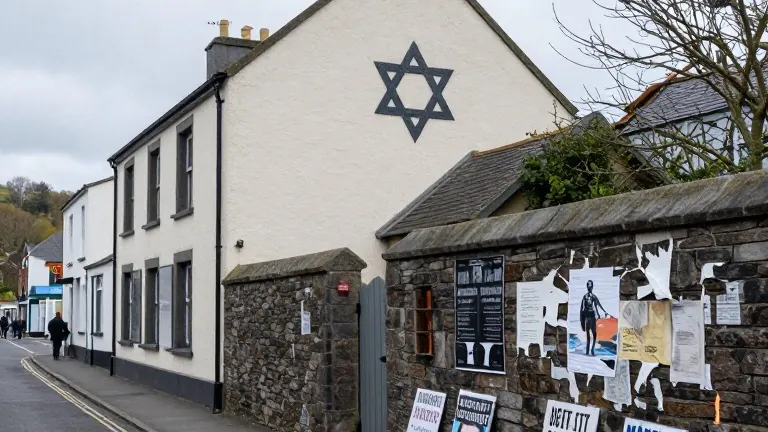
Nathan Abrams, a professor at Bangor University and author of a new book on the history of Jews in Wales, argues that the small size of the community has amplified the impact of prejudice. Abrams, who has lived in Wales for twenty years and speaks Welsh fluently, notes that for 15 centuries, Wales had no Jewish residents. He says this historical absence created a fascination with Jews that is inversely proportional to their actual numbers. "The absence of Jews hasn't meant the absence of antisemitism; it's actually the opposite," Abrams said. He describes the current climate as one of "ambient antisemitism," where posters are ripped down and stickers are put up, creating an environment that feels hostile even without physical violence.
The political context in Wales complicates the picture. The left-leaning nationalist party Plaid Cymru holds an official stance critical of Israel and supportive of Palestine. In September 2025, the party leader called for harsh sanctions against the Israeli government. Abrams observes that this political position feeds into an "obsession with Israel" that often manifests as antisemitism among people who do not believe they are being biased. He notes that much of this attitude comes from older, middle-class individuals who are polite but repeat historical tropes about Jews. "They won't know that this emphasis on killing babies has been used throughout history," he said.
Jewish community representatives recently met with the Welsh Local Government Association to discuss these trends. During the meeting, leaders described growing anxiety about routine verbal abuse and concerns for children in schools. They noted that some Jews are changing their behavior in public to avoid identification. The South Wales Jewish Representative Council stated, "We are a resilient community, but there is no doubt that the rise in antisemitism in recent years has left many people shaken and concerned."
Wider policing data for Wales shows that 6,157 hate crimes were recorded between April 2025 and March 2026. Of these, 325 were motivated by religion, a decrease from 451 in the previous period. The Community Security Trust separately recorded 25 antisemitic incidents geographically associated with Wales during 2025. These numbers suggest that on-the-ground experiences may differ from official police categories, as some incidents are reported to the Trust but not classified as anti-Jewish by police.
The next step involves the Welsh government reviewing its hate crime reporting standards to ensure religious targets are consistently identified. Community leaders expect further meetings with local councils in the coming months to address specific safety concerns in schools and public spaces.
Source: The Jerusalem Post