Why Horror Films Keep Returning to Catholic Rituals
A new book and filmmakers point to specific Catholic themes, from exorcism rites to suffering, as material for horror plots.
By Amina Yusuf ·
Horror films have long drawn on Catholic imagery and doctrine, from the exorcism scenes in "The Exorcist" to the satanic lineage described in "The Omen" and the demonic birth in "Rosemary's Baby." Director Aislinn Clarke, who grew up Catholic, said the church's rituals offered ready material for the genre. "The priest holds up a cup and says, this is the blood of Christ, this is the body of Christ," she said, recalling that as a child interested in horror she thought, "this is a bit like cannibal-ish."
The genre's reliance on these elements is the subject of "Body And Blood," a new book co-authored by Matthew Cressler that examines Catholic horror. Cressler said Catholicism offers theological themes that fit the genre's concerns. "Catholics have long had a sense that when one suffers, one is bearing the cross of Christ and that, like, in suffering, one is drawn closer to Christ," he said. He also noted that horror films can portray a vampire at the door or a possessed child, adding, "you don't, like, call for a Methodist."
Filmmakers have put these ideas to work. In "Saint Maud," a devoutly Catholic nurse lines the soles of her shoes with metal spikes to recreate Christ's suffering. Clarke's 2018 film "The Devil's Doorway" includes bleeding statues and demonic possession, but she said the scene she found most disturbing shows nuns singing hymns while ignoring the young woman giving birth before them.
Reverend Aaron Williams, a pastor at St. Mary's Basilica in Mississippi, consulted on the 2025 film "The Ritual." He said ordinary Catholics may not hold the views portrayed in some films, but the church does maintain a rite of exorcism. "A priest has no authority on his own, but through ordination, he's sacramentally received a character that allows him to act with the authority of Christ," Williams said. He also noted that most people encounter sin through ordinary temptation rather than direct contact with the occult.
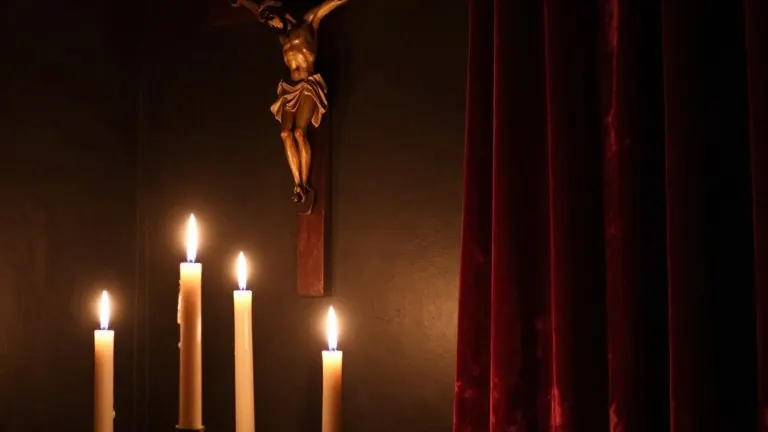
Cressler said Catholic themes appear even in films not overtly religious, pointing to the plot of "Psycho," in which a mother's mummified corpse is kept in a house. He also said the accumulation of candles, crosses and statues in a room can signal danger in a film. "If you walk into a room that's got too many candles and too many crosses and too many statues, you know you're in trouble," he said.
Source: KHPR