Güzelyurt: 1,600 Years of History in Turkey's 'Beautiful Land'
A town on the edge of Cappadocia preserves a unique blend of Greek and Turkish heritage, with residents maintaining daily routines in a landscape shaped by centuries of cultural exchange.
By Sarah Reynolds ·
Güzelyurt, a town located on the periphery of Cappadocia in central Turkey, serves as a site where historic Greek, Turkish, Kurdish, and Bulgarian communities coexist in relative peace.
Situated at the edge of the Ihlara Valley, the town is approximately 35 miles from the regional capital of Nevşehir. The area is characterized by minimal tourism, extensive history, and a distinct local character that Rick Steves, a travel writer, identifies as one of his favorite discoveries in the region.
The town’s central market square features a prominent bust of Mustafa Kemal Atatürk, the founder of modern Turkey. The square is a hub of daily activity where residents drink sweet çay and play backgammon. The presence of the bust reflects Atatürk’s insistence on the separation of mosque and state, a principle that defines the modern Turkish identity in this historic locale.
Historical records indicate that Güzelyurt was predominantly Greek until the early 1800s, when Greece and Turkey were both parts of the Ottoman Empire. During this period, Greek Orthodox communities existed in Turkey, while Muslim communities lived in Greece. In the 1920s, the Greek and Turkish governments agreed to a large-scale population swap. Most Christians in the region were sent to Greece, and most Muslims in Greece moved to Turkey, altering the religious demographics of the area.
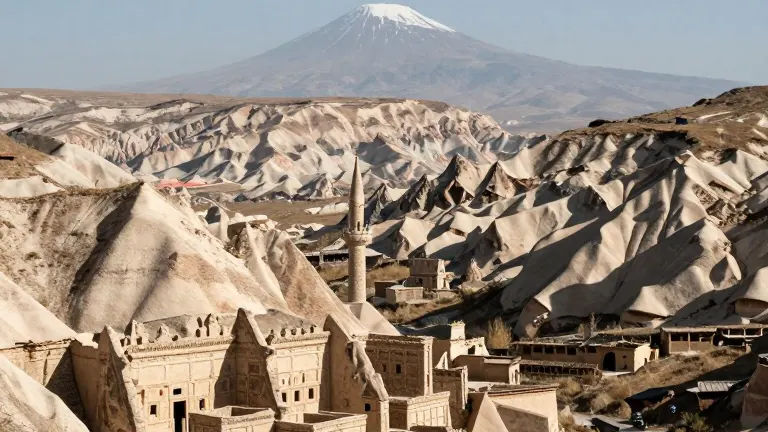
The architectural landscape of the town reflects these historical shifts. A former church dedicated to St. Gregorius, built in 385, now functions as a mosque, marked by a single minaret. The structure sits below a cliff face that contains a layer of different building styles, including troglodyte caves, Seljuk arches, and Ottoman facades. Above these older structures, the tin dome of a 20th-century mosque with twin minarets rises into the sky.
Residents continue to inhabit parts of the old town, maintaining homes in crumbling terraces and neglected gardens. The area offers a view of the lush gorge where monks carved monasteries into the volcanic rock cliffs 16 centuries ago. While erosion has driven many residents to more stable dwellings, some remain in the ancient structures, demonstrating a tenacity for their community that observers note as a defining trait of the town’s people.
Daily life in the ravine and surrounding hills includes traditional practices such as goat herding and the playing of flutes carved from eagle bone. In a scene observed in the community, a young boy played such an instrument while his mother cooked, while his father tended to goats on a nearby hillside. The father played his flute to signal that all was well, a practice used by herding families in rural Turkey for generations to maintain family connection across distances.
The town’s name, Güzelyurt, translates to “beautiful land” in Turkish. This name is spelled out in white rocks on a nearby hillside, visible to those hiking the area. To the left, the snowy volcanic slopes of Mount Hasan dominate the horizon. For the residents, the town represents a specific identity and a preferred place to live, a sentiment shared by visitors who find the area’s blend of cultures and history compelling.
The community’s resilience is evident in the continued use of the area for daily chores and social interaction. The sounds of children playing, neighbors chatting, and animals moving through the streets create a consistent backdrop to life in Güzelyurt. The town remains a place where fragile traditions are preserved, offering a glimpse into a way of life that has changed little over the centuries.
Source: Everett Herald · original report published
More News · Marysville news · Report a business · Got a Story?