Lynnwood Council weighs 24/7 speed cameras at school zones
The city's proposed 2027-28 budget includes expanding traffic enforcement and adding new cameras on 44th Avenue West to address a budget deficit.
By Matthew Collins ·
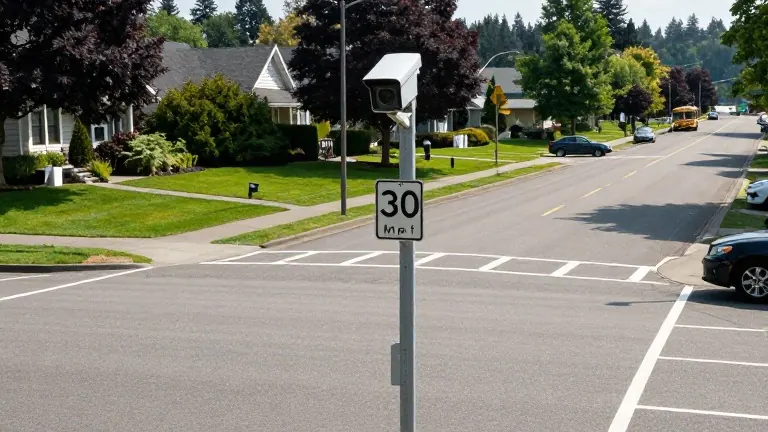
The Lynnwood City Council began reviewing a proposal on Monday to expand its automated traffic safety camera program. The plan, part of Mayor George Hurst’s 2027-28 budget, would extend school zone speed cameras from drop-off and pick-up hours to 24-hour operation. The city would also install two additional speed cameras on 44th Avenue West between 164th Street Southwest and 168th Street Southwest. Police officials identified this stretch as a high-risk area for crashes due to vehicle speed.
The expansion is intended to generate revenue to help close a budget deficit. In 2025, the city faced a deficit partly caused by lower-than-expected revenues from red-light cameras, permits, and sales tax. The proposed budget estimates an additional $1.1 million in revenue from fines and forfeitures between 2025 and 2027, with another $1.1 million increase in 2028. Interim Finance Director Monisha Harrell stated that these revenue projections are conservative because the city cannot afford to miss forecasts. She noted that the numbers are essential for closing the budget but are not overly optimistic.
Lynnwood has operated red-light cameras since 2007. School zone cameras were installed in 2009 near Lynnwood Elementary and the Meadowdale area, which serves Meadowdale elementary, middle, and high schools, as well as Beverly Elementary. Police reported that the number of school zone violations has remained relatively stable over the years. The city aims for the 24-hour expansion to be more effective in slowing drivers. Other Washington cities, including Edmonds, Federal Way, Kenmore, and Lake Forest Park, have recently expanded their school zone camera hours.
Deputy Police Chief Chuck Steichen said the city must determine the specific speed threshold for violations outside of school hours. The draft ordinance sets a $145 fine for speed infractions, based on the regular 30 mph speed limit. State law allows cities to install one additional speed camera per 10,000 residents in areas with a high risk of speed-related crashes. City staff referred to the 44th Avenue West area as the "S-curves" after a collision analysis. Steichen said the section has had speeding and collision problems for decades, including fatalities since he was hired 30 years ago.
Judge Valerie Bouffiou of the Lynnwood Municipal Court revised her estimate of the program's processing costs. She initially projected an annual cost of $750,000 in October but lowered the estimate to less than $540,000 on Monday. She explained that the city does not need to train all staff simultaneously because the cameras will not turn on at once. Steichen estimated that school zone cameras would begin 24-hour operation in January. After a 30-day grace period, the city would begin collecting revenue in February. Revenue collection for the new 44th Avenue West cameras may not begin until spring or early summer.
State law restricts how the city uses revenue from speed cameras. Funds must cover program costs and traffic safety. After four years, 25% of any revenue not covering these costs must go to the state. Revenue from red-light cameras has no such restrictions.
Council members expressed mixed views on the proposal. Council member Isabel Mata said she did not like depending on people breaking the law for revenue but acknowledged it as a way to fund important city services. Council member Robert Leutwyler expressed disappointment that the city had not conducted "road diets," which convert four-lane streets to three lanes with a center turn lane. He noted that road diets are a widely accepted practice for safer driving. Public Works Director Jared Bond said the city previously considered a road diet on 168th Street Southwest but rejected it due to drop-off traffic impacts. The city plans to reconfigure 164th Street in 2028 using a Puget Sound Regional Council paving grant.
Council President Nick Coelho said he would vote on the proposal as a public safety measure. He requested a public-facing dashboard to track if the expansion changes driving behavior. The council will hold another discussion on the program before voting on Nov. 23. The discussion coincided with S&P Global Ratings lowering Lynnwood's bond rating from AA+ to AA. The agency cited reduced reserves from operating deficits, capital transfers, and jail construction delays. S&P gave the city a stable outlook due to recent budget-balancing measures, including a public safety sales tax.
Mayor Hurst urged the council to pass the proposed budget, which includes the camera expansion and a property tax increase. He called the S&P report a wake-up call. He stated that final approval of the 2027-28 budget is essential for the city's financial future.
More News · Marysville news · Report a business · Got a Story?