Zeinab Faraj survives drone strike in al-Tiri while colleague Amal Khalil dies
Faraj was trapped under rubble for an hour after Israeli forces struck a ceasefire zone, killing the veteran reporter who had protected her with her body.
By Matthew Collins ·
Zeinab Faraj can no longer climb stairs without pain. The 21-year-old photojournalist is returning to university in Bellingham, but a limp and a visible injury to her hand mark her every step. These physical scars are the result of a strike in southern Lebanon that left her trapped under rubble while her colleague, Amal Khalil, died beside her.
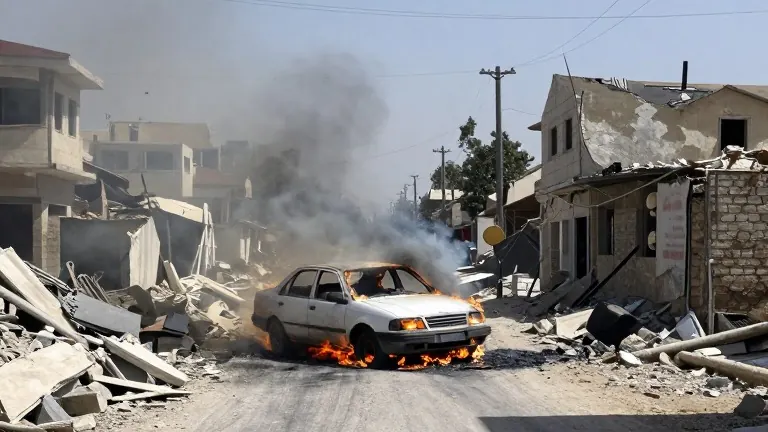
The attack occurred on the afternoon of April 22, shortly after Israel agreed to a ceasefire. Faraj and Khalil, a 42-year-old newspaper reporter, had traveled to the village of al-Tiri to document the war damage. They were following a car driven by Ali Nabil Bazzi, a 27-year-old municipal official, and Mohammed Hourani, a 37-year-old local friend. The group had met earlier that day at Tebnine governmental hospital, which residents used as a safe gathering point.
Faraj did not hear the first missile. She heard Khalil scream and saw the car ahead of them catch fire. The two women stepped out of their vehicle to assess the situation. Faraj moved closer to the burning car, hoping to pull Bazzi out, while Khalil repeated that they were gone. Faraj later described seeing the bodies of Bazzi and Hourani torn apart by the blast.
Drones appeared shortly after the initial explosion. Faraj described one flying close to her face, dipping and rising as she tried to cover herself. She and Khalil called emergency services, who promised help was on the way. A paramedic told them to drive back up the road because ambulances were blocked. As they attempted to re-enter their vehicle, a second missile struck.
The impact threw both women backward. Khalil wrapped her arms around Faraj as a drone circled overhead. Khalil hoped the drone would assume they were dead. Blood covered Khalil’s face, hand, and leg. Faraj sent a final text message to her sister before her phone died: “There’s no hope left. Forgive me.”
The pair took shelter in a nearby house. Khalil could not move, so Faraj crawled to a position to watch the road. A drone descended toward her again, prompting her to feel detached and alone. Then a missile fell with a sound Faraj said she had never heard before. When she opened her eyes, a heavy weight pressed down on her body, blocking her breath and leaving her in darkness.
A paramedic eventually reached the scene. Faraj clung to him, telling him not to leave her because she was afraid to stay alone. He stayed with her while a second worker cleared the rubble. As they pulled her free, a stun grenade dropped from a drone. Faraj kept mistaking the ambulance engine for a drone until they reached a hospital.
Faraj asked the nurses about Khalil. They fell silent, confirming the reporter was gone. Khalil is believed to have died about an hour before the paramedics were allowed to return to the area. The Israeli military justified the attack by identifying saboteurs violating the ceasefire. Human rights groups called it a war crime. A week prior, an Israeli military spokesperson had labeled a video of Khalil as “terrorist media.”
Faraj now wakes at night screaming and buries herself in pillows to escape the sound of drones. She remains haunted by the image of Hourani lying on the ground with his eyes open. She describes her life as a fish suffocating when taken out of water, a feeling that intensified when she returned to the area where she was born in Bint Jbeil.
Source: The Guardian